Monday, January 30, 2012

East of Eden

Before last week my exposure to Steinbeck consisted of the usual: The Grapes of Wrath (read at PUC) and Of Mice and Men (high school). When I thought of Steinbeck I pictured dust, California, downtrodden farmers, more dust, and mentally unstable giants who suffocate puppies and women (by accident, of course). 

While East of Eden contained all of these elements (except Lennie), it was far more complex than I anticipated. The first 70 pages of the story dragged a bit, but when Cathy Ames (aka Kate) came onstage, I was hooked. Cathy is probably one of the most heinous characters I have ever encountered. She puts Dracula, Dorian Grey, Elkenah Bent, and Mr. Hyde to shame. She is horrible; therefore, she is interesting. Vampirism, magic mirrors, and secret potions are not to blame. She is evil incarnate: malicious, depraved, destructive, and completely human. 

Here's one description of her:

Cathy was chewing a piece of meat, chewing with her front teeth. Samuel had never seen anyone chew that way before. And when she had swallowed, her little tongue flicked around her lips. Samuel's mind repeated, "Something - something -can't find what it is. Something wrong," and the silence hung on the table. (171)

Here's another description of her when she's giving birth to her twins:

Her head jerked up and her sharp teeth fastened on his hand across the back and up into the palm near the little finger. He cried out in pain and tried to pull his hand away, but her jaw was set and her head twisted and turned, mangling his hand the way a terrier worries a sack. A shrill snarling came from her set teeth . . . He stepped back from the bed and looked at the damage her teeth had done. He looked at her with fear. And when he looked, her face was calm again and young and innocent. (191) 


Since we're working with allegory in this novel, her snake-like qualities are intentional. 
East of Eden is set mainly in the Salinas Valley and Steinbeck was aiming for a primordial significance that parallels themes found in the book of Genesis: father/son relationships, redemption, and freedom of choice. I found the most fascinating theme of this book to be the question of inherited sin. Following three generations of characters whose morality ranges from good, bad, evil, and everywhere in-between, the conclusion is that everyone has a choice as to whether they will choose good or choose evil. Humanity is not predestined to make the choices that that their parents made and they are not doomed by genetics to act in a certain way. The philosophy might be a little heavy, but reading this book was effortless. 
I love Steinbeck’s straightforward prose. He’s never over the top with description, yet he still manages to be poetic. 
“It was a deluge of a winter in the Salinas Valley, wet and wonderful. The rains fell gently and soaked in and did not freshet. The feed was deep in January, and in February the hills were fat with grass and the coats of the cattle looked tight and sleek. In March the soft rains continued, and each storm waited courteously until its predecessor sank beneath the ground. The warmth flooded the valley and the earth burst into bloom - yellow and blue and gold” (308).  
I’m not a huge American Literature person, but I do want to read more Steinbeck. When I read Steinbeck I know I am encountering greatness in a novelist. 

Saturday, January 28, 2012

The House at Tyneford

I scooped up Natasha Solomons book, The House at Tyneford (2011), on one of our Costco trips a couple of weeks ago because the sales plug on the cover caught my eye: “Fans of Downton Abbey and Kate Morton’s The Forgotten Garden will absolutely adore The House at Tyneford.” 


Well, I’m a huge fan of Downton Abbey and I’ve been told I will like The Forgotten Garden, but I didn’t exactly adore this book. It was o.k. It kept me entertained. For the most part though, it was kind of dreary and morose. There was none of the sparkle of Downton Abbey and even less of the addicting intrigue.
The premise of the story was interesting. It is 1938 and Elise Landau is a 19-year-old Jewish girl living in Vienna. Her mother is a famous opera singer and her father a well-known philosophical writer of novels. She has always been taken care of, is somewhat spoiled, and used to parties and champagne. She is not as beautiful, talented, or graceful as her older sister, and this gives her a bit of a complex. In order to keep her safe her parents send her off to England to become a parlour maid. Obviously, she begins her new life resentful and forlorn, but she is transformed when she strikes up a friendship with the son of the master of Tyneford, Kit. The rest of the novel revolves around her romance with Kit, her relationship with her sister (who has fled to California with her husband), and trying to figure out how to rescue her parents from Vienna. 
If you’re going to read this book, be warned, Solomons writing is bloated with description. 
In terms of style, the first page of her novel was an easy indicator of things to come. In-fact, Solomons seems to have copied her style directly from Daphne Du Maurier’s 1938 classic, Rebecca. 
Here is a sample of the first couple of paragraphs from Rebecca:
“Last night I dreamt I went to Manderley again. It seemed to me I stood by the iron gate leading to the drive, and for a while I could not enter, for the way was barred to me. There was a padlock and a chain upon the gate. I called in my dream to the lodge-keeper, and had no answer, and peering closer through the rusted spokes of the gate I saw that the lodge was uninhabited. No smoke came from the chimney, and the little lattice windows gaped forlorn. Then, like all dreamers, I was possessed of a sudden and supernatural powers and passed like a spirit through the barrier before me. The drive wound away in front of me, twisting and turning as it had always done, but as I advanced I was aware that a change had come upon it; it was narrow and unkept, not the drive that we had known.”  
Here is a portion of the opening paragraph of The House at Tyneford:
“When I close my eyes I see Tyneford House. In the darkness as I lay down to sleep, I see the Purebeck stone frontage in the glow of late afternoon. The sunlight glints off the upper windows, and the air is heavy with the scents of magnolia and salt. Ivy clings to the porch archway, and a magpie pecks at the lichen coating a limestone roof tile. Smoke seeps from one of the great chimneystacks, and the leaves on the unfelled lime avenue are May green and cast mottled patterns on the driveway. There are no weeds yet tearing through the lavender and thyme boarders, and the lawn is velvet cropped and rolled in verdant stripes. No bullet holes pockmark the ancient garden wall and the drawing room windows are thrown open, the glass not shattered by shellfire. I see the house as it was then, on the first afternoon.” 
Eerily similar, are they not? I don’t suppose it’s a crime to copy someone else’s style, but by the time I got to the last 50 pages I just wanted to plow through the description of every hill, flower, wave, and cloud so I could get on with the story line. In the end, even though the characters weren't overly lovable and the plot was a bit transparent, I would recommend this book to anyone who wants a light weekend read. Just don’t expect anything nearly as tantalizing as Downton Abbey, no matter what the book cover says! 

Saturday, January 21, 2012

Angle of Repose

Usually, when I hear the phrase, “Western literature,” I have visions of sagebrush, haggard, craggy-faced women in unflattering calico dresses husking corn on their front stoop, and simple God fearin’ folk singin’ hymns. So last week when I picked up Wallace Stegner’s Angle of Repose, I automatically assumed I was entering the world of buffalo chips and butter churns. 
Sometimes, I’m such an ignoramus. This book was brilliant (the Pulitzer Prize committee also thought so in 1974). My notions of what a “Western” writer is have been turned upside down. With compelling and complex relationships between characters and poetic and elegant prose, Wallace Stegner is the Henry James of the West. Here’s an example of the richness of his writing: 
"In that latitude the midsummer days were long, midsummer nights only a short darkness between the long twilight that postponed the stars and the green dawn clarity that sponged them up. All across the top of the world the sun dragged its feet, but as soon as it was hidden behind Midsummer Mountain it raced like a child in a game to surprise you in the east before you were quite aware it was gone from the west. One summer out of four, when the moon was nearing or at or just past the full, there was hardly anything that could be called night at all."

What is this story about? I'm too lazy to summarize for myself, so I'll let my book jacket do it:

"Angle of Repose tells the story of Lyman Ward, a retired professor of history and author of books about the Western frontier, who returns to his ancestral home of Grass Valley, California, in the Sierra Nevada. Wheelchair-bound with a crippling bone disease and dependent on others for his every need, Ward is nonetheless embarking on a search of monumental proportions - to rediscover his grandmother, now long dead, who made her own journey to Grass Valley nearly a hundred years earlier."

The story flips back and forth between Lyman, with his difficult relationships and realizations about himself and his ancestors, to a narrative on Susan Ward's (his grandmother) life. This narration is furthered by interspersing letters that his grandmother wrote to her cultured friend back East. His grandmother is an artist and her husband, Oliver, an engineer and the clashing of their temperaments and desires is juxtaposed against the varied landscapes of New York, Colorado, Mexico, Idaho, and California. 

Stegner made me realize that despite that harsh realities of Western life, cultured people who thought there was more to life than just eking out an existence, didn’t just exist in the East. I love reading novels set in sprawling English estates teeming with aristocrats, butlers and maids, but suddenly the West has captured my imagination with a grace and honesty that makes the glitter of chandeliers and the gleam of polished silver seem dull by comparison. 


Saturday, January 7, 2012

Honolulu by Alan Brennert

What better book to indulge in on a snowy January day than one with sparkling ocean waves, gently swaying palm trees, and the scent of plumeria, jasmine, and tuberose mingling in the air? That’s what I thought to myself as I grabbed Alan Brennert’s Honolulu off the shelf with my freezing cold hands a few days ago. Even though this book is 431 pages, it reads very fast. The story is narrated by a Korean picture bride, Jin, who leaves the oppressive world of Korea for the hope of a better life in Hawaii in the early 20th century. This was a fascinating and well told story which weaved together the history of Hawaii (in particular, the city of Honolulu) with that of the Korean culture. I learned much about the relationship between Japanese and Koreans during the early 20th century and Confucian ideals of women. As with many cultures, women were expected to keep their faces covered, to live in the “inner room” of their homes while the men occupied the “outer rooms,” and they were denied an education (it was seen as shameful and dangerous for a woman to have too much knowledge), and they could never look a man directly in the eyes. I found this slightly disturbing, as I am using a Confucius quote on one of the handouts I made for my students. I didn’t know he was such a sexist pig! Sometimes, great thinkers have some great flaws. In any case, I highly recommend this book. Now, not only do I want to return to Hawaii and bask in some warm rays and breath in the sweet scent of the island (which would be much better than the stench of manure that’s been floating on the ice cold breezes of Logan), but I really want some kimchi! It’s been too long! I wonder if I can convince Miles to accompany me for some Korean b.b.q.... 


Wednesday, January 4, 2012

My Beloved Queen!

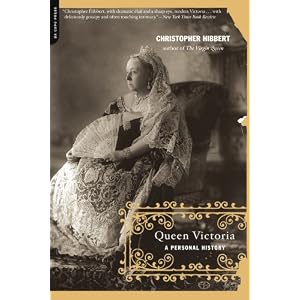
Miles gave me Christopher Hibbert’s book, Queen Victoria: A Personal History, for Christmas and I’ve thoroughly enjoyed reading it over the past few weeks. I don’t usually read Biographies, so when I reached page 502 this evening I felt both accomplished and exceedingly more intelligent and informed!  


There was certainly a lot of provocative information in this volume, but for the sake of brevity (and fear that no one would read further) I’ve only chosen ten things that stood out to me:
  • Queen Victoria liked to eat a lot and to eat fast (I can relate). She was always prone to chubbiness and became quite corpulent in her old age. When she was younger, Lord Melbourne suggested that she might try eating only when she was hungry. She retorted that “she was always hungry . . . so, if she followed his advice, she would be eating all day long” (77).  
  • She liked to keep rooms cold (58 degrees, to be exact) and once, when she noticed that the temperature in her room had reached an offending 60 degrees, she had the flames of the fire doused. She didn’t seem to care that everyone else was freezing to death. Visitors to Balmoral, her Scottish Estate, were almost always cold and uncomfortable. Tsar Nicholas II said that it was, “colder than the Siberian wastes” (181).  
Balmoral: I guess Castles are supposed to be cold...
  • She hated long sermons and would glare at the preacher and/or tap her foot if they got long-winded 
  • She had one of those personalities where if someone told her to do something, she wouldn’t do it, just for the sake of being stubborn. Though she was domineering, the people she liked best seemed to be those who stood up to her. 
  • She was prone to uncontrollable bursts of laughing. 
  • She was a walking contradiction: self-centered, strong-willed, decisive, determined and opinionated; yet she was often described as shy, charming and childlike. 
  • She was prone to violent outbursts of temper that her calm and collected husband, Prince Albert, found quite alarming. Often she would lose her temper with him and then storm after him when he tried to leave the room. This resulted in Albert shutting himself up to write long letters to Victoria in which he would try and reason with her. Eventually, she would calm down and be penitent for her outbursts.
  • She was madly in love with Albert and though not very attractive herself, she always liked to have handsome men around her. 
  • Upon discovering that she had become pregnant so soon after her marriage she described it as, “the ONLY thing” she dreaded, she was “furious,” it was “too dreadful,” “she could not be more unhappy” and to the Dowager Duchess of Saxe Coburg-Gotha she said, “I am really upset about it and it is spoiling my happiness; I have always hated the idea and I prayed God night and day to be left free for at least six months . . . . I cannot understand how anyone can wish for such a thing, especially at the beginning of a marriage” (130). By the time she had child number nine she had warmed up to the idea of having babies (she never veered from her opinion that giving birth made her feel like a “rabbit or a guinea-pig” though), but Victoria’s maternal instincts seem to have been a bit wanting at times. 
  • She loved her dogs so much that she had them properly buried and had monuments erected in their honor.

The thing I love most about Queen Victoria is that she was a woman who didn’t pretend and didn’t mind being excessive in her feelings. She said exactly what she thought and didn’t try to hide either dislike, impatience, or the great love she felt for her country, her husband, her dog, and anyone else she felt particularly close to.